Moroccan ingredients
How to Soften Dry Skin Overnight: The Moroccan Prickly Pear Seed Oil Ritual
Two or three drops of zit l-hindia on damp skin at night: the Moroccan way to use prickly pear seed oil, and how to tell a real bottle.
 By Fatima AmgharMoroccan beauty editor at Bodywhatever™
A few drops, at night, on damp skin
Zit l-hindia, prickly pear seed oil, is one of the rarest oils to leave Morocco. It takes a mountain of seeds to fill a small bottle, which is why a real one is never cheap and never scented.
Moroccan women use two or three drops on the face at night, pressed into skin that is still slightly damp — the same finishing gesture as argan after the hammam, only lighter. If a bottle smells like perfume or costs what a simple oil should cost, it is probably not the seed oil.
Why a few drops are enough
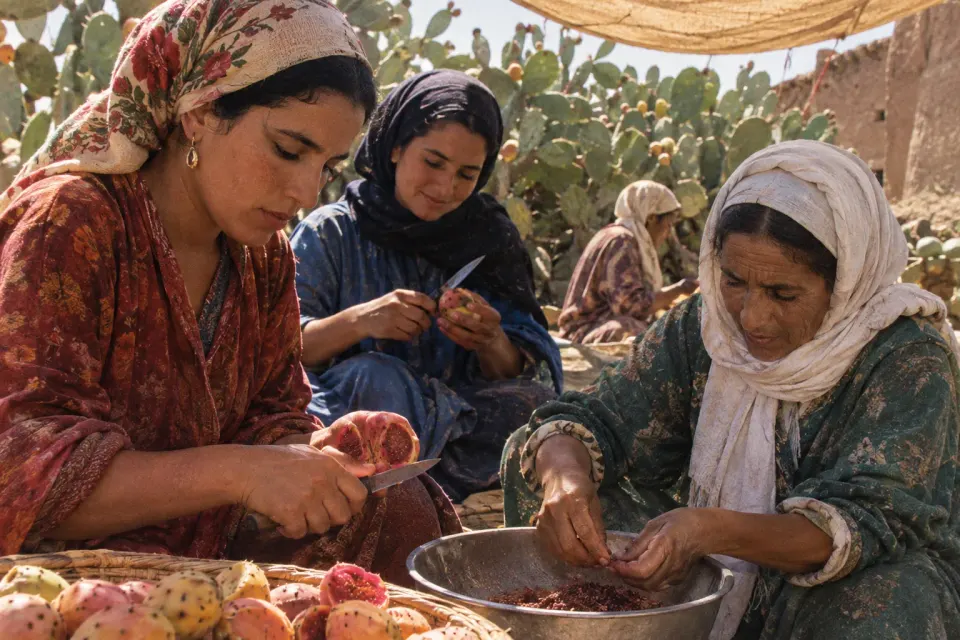
The prickly pear cactus grows as a hedge around villages across southern Morocco. In summer its fruit, l-hindia, is sold peeled from carts on every street corner and eaten fresh. The oil is somewhere else: in the tiny hard seeds most people spit out. Each fruit holds very few, and they give up very little. In many regions women's cooperatives harvest the fruit, separate and dry the seeds, and press them in small mills. That work is what you pay for in a real bottle, and it is why nobody in Morocco pours this oil. They count it.
The order of the ritual has a reason. Oil does not add water to your skin; it holds in the water that is already there. So the water comes first, from washing your face or from a mist of ma ward, rose water, and the oil comes last, while the skin is still damp. Put on dry skin, the same drops sit on top and shine. On damp skin they melt in, and your face feels supple, not greasy.
It is a night gesture because the night gives it hours. Zit argan, argan oil, is the everyday Moroccan oil: richer, more generous, used after the hammam from face to feet. Zit l-hindia is the lighter, drier cousin, kept for the face, the eye area and the neck, and for the evenings when your skin feels tight after a day of sun, wind or air conditioning. It is the last gesture of the day, and nothing more complicated than that.
1. Wash your face and stop drying early
Use your usual gentle cleanser and lukewarm water. Pat your face with the towel just until it stops dripping, then stop. Your skin should still feel cool and slightly damp under your fingers. Tie your hair up before you start, so the oil stays on your skin and not on your hair.
2. Add a mist of ma ward if you have it
In a Moroccan bathroom the rose water is never far from the oil. Two or three sprays over the face, the neck and the top of the chest give the oil more water to hold. If you have none, the water left on your skin from washing does the job. Do not wait for it to dry.
3. Warm two or three drops in your palms
Let two drops fall into the hollow of your palm, three if your skin is dry or the air is cold. Rub your hands together slowly for a few seconds, until the oil is warm and your palms shine. Warm oil spreads further, and that is how two drops become enough for a whole face. In hot, humid weather begin with two. You can always add the third.
4. Press it in, do not rub
Lay your palms flat on your cheeks and press, then your forehead, then your chin. No rubbing, no pulling: press and lift. If you like, finish with one slow minute of flat fingers gliding from the center of the face outward. Then put a single extra drop on your two ring fingers and tap it lightly around the eyes, where the skin is thinnest and this light oil is most welcome. Your face should feel soft, not shiny.
5. Take it down to your neck and chest
Moroccan women do not stop the oil at the chin. Warm two or three more drops and smooth them with flat hands from the top of the chest up to the jaw, one side then the other. The skin there is thinner than on the face and sees the sun every day. Wait two minutes before you dress for bed: the oil sinks in fast and leaves almost nothing on the surface. The next morning, take your sunscreen down to the neckline too. It is the kindest thing you can do for this skin.
6. Give what is left to your hands and your dry ends
Not a single drop of this oil should be lost. Press what remains on your palms around your nails and over the backs of your hands. If your ends are dry, add one drop, rub your palms together and press the last 2 inches (5 cm) of your hair between them. Nothing above the shoulders, and no rinsing: by morning the ends are soft and the oil is gone. It is one of the lightest Moroccan oils and it leaves no film, which is why it suits fine hair that every other oil weighs down. A touch of a fingertip is enough to lay down the flyaways around your bangs.
7. On hammam night, remember your heels and elbows
After the weekly hammam, when the skin has been warmed, softened with saboun beldi, the black soap, and scrubbed with l-kissa, the kessa mitt, rough places take oil beautifully. Heels and elbows are thick skin that makes very little oil of its own. Leave them slightly damp, press two or three drops into each one, and massage the rough edge of the heel with your thumb for half a minute. Skip any spot where the skin is open.
Pull on clean cotton socks straight away, before you walk anywhere, so the oil stays on your heels and not on the floor or the sheets. Elbows can stay bare or go under a long cotton sleeve. Twice a week is plenty to start, on hammam night and once midweek. Keep the socks next to the bottle on your bedside table and you will never forget. And if the bottle feels too precious for feet, zit argan does this job just as well.
If pure oil feels like too much
There is a gentler way to meet this oil, and it is lovely when the air is humid or your skin is oily. Put your usual night moisturizer in your palm, add one drop, and stir with a fingertip until you no longer see the oil. The cream turns a little glossier, and the drop travels over your whole face in a thin, even layer. Mix it in your palm each night, never in the jar, so the cream stays as it was made. On nights when your hands are dry too, do the same with your hand cream.
If your skin is oily or breaks out easily, go slowly: one drop, once a week, and see how your face feels the next morning. If it is happy, move to twice a week. There is no shame in keeping the bottle for the cooler, drier nights.
And if your skin feels thinner and drier than it did ten years ago, the ritual stays exactly the same: three drops for the face, one for the eyes, one slow minute of your own hands. No oil turns back time, and we will not pretend otherwise. Well-moisturized skin simply looks smoother and feels more comfortable, and that part is real.
The mistakes almost everyone makes
Using too much. A full dropper is argan thinking. With zit l-hindia, more than three drops on the face is simply wasted, and it is an expensive thing to waste.
Putting it on dry skin. Then it sits on top, it shines, and you decide the oil does nothing. Damp skin first, every time.
Rubbing. The gesture is a press. Rubbing pulls the skin and leaves half the oil on your hands.
Wearing it in the morning. Keep it for the night, when it has hours to sink in. In the daytime your moisturizer and your sunscreen are all your face needs.
Asking it to do the work of water. If your skin is thirsty, oil alone will not change that. It only keeps in what you gave your skin first.
Leaving the bottle on a sunny shelf. A precious oil likes the dark. Keep it in a drawer, with the cap closed tight.
Counting the nights. Your face feels softer the next morning, but rough heels need a few weeks. Regularity matters more than the amount of oil.
How to choose a real bottle
Read the back of the bottle, not the front. A real one has a single line in its ingredient list: Opuntia ficus-indica seed oil. Nothing before it, nothing after it, no fragrance. It comes in a very small bottle, usually half an ounce to one ounce (15 to 30 ml), in dark glass with a dropper, and the price is high for the size. Now you know why.
In your palm the oil is thin and almost dry to the touch, pale gold with a hint of green. It has a faint smell of its own, a little grassy, a little nutty, that fades within a minute. It sinks in fast and leaves no film.
Refuse the big, inexpensive bottle: it is almost always another oil with a little prickly pear in it. Refuse anything that smells of perfume. And watch the words on the front. Prickly pear oil without the word seed is often a macerate, cactus flowers or pads soaked in a cheaper oil, which is a different product. Prefer a seller who can tell you where the seeds come from and how the oil was pressed. A Moroccan grandmother would ask exactly that, and she would walk away from a vague answer.
One small bottle is enough. At two or three drops a night, half an ounce (15 ml) lasts for months.
Related ingredients
Common questions
Questions about this care
How often should I use prickly pear seed oil on my face?
Start with three or four nights a week, two or three drops each time. If your skin loves it, make it every night. Oily skin starts lower: one drop, once a week.
Can I use prickly pear seed oil in the morning, under sunscreen?
Keep it for the night. In the morning, moisturizer then sunscreen is enough, and the oil is too precious to wear under makeup where it has no time to sink in.
Is prickly pear seed oil good for oily or breakout-prone skin?
It is a light oil, but every skin is different. Begin with one drop stirred into your night moisturizer, once or twice a week, and watch how your skin takes it. If it feels heavy, a lighter step may suit you better.
Prickly pear seed oil or argan oil for the face?
They are not the same oil. Argan comes from the kernel of a tree, prickly pear from cactus seeds. Both suit the face. Prickly pear is lighter and sinks in faster, so it is lovely around the eyes; argan is richer and costs much less. Many women keep prickly pear for the face and argan for the body and hair.
Can I use prickly pear seed oil on my hair?
Yes, on dry ends, with the drop left after your face: press it into the last 2 inches (5 cm) and leave it in. You can massage a drop or two into the scalp before a wash, but for the scalp and for everyday hair care argan does the same job for far less.
Does prickly pear seed oil help with wrinkles?
No oil turns back time. What this one does is keep water in the skin, and skin that is well moisturized looks smoother and feels more comfortable. Daily sunscreen does more for fine lines than any oil.
Can I use another oil for the heels and the socks?
Yes. Argan oil or any body oil you like works the same way: a few drops on damp skin, then clean cotton socks for the night. Keep it for nights at home and use a cream during the day.
Body Notes Journal
Ingredients, rituals and local finds for your routine
Discover Moroccan beauty traditions, learn how to use the ingredients and find products available locally.
By subscribing, you agree to receive these emails. You can unsubscribe at any time.