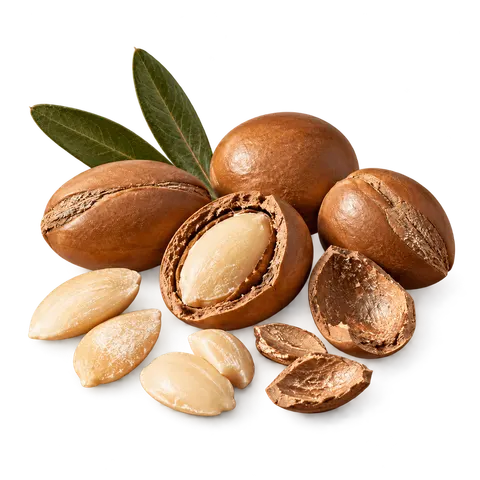
Product for this step
Oil · Amazon.com
0 reviewsMoroccan ritual & routine · Step by step
Two drops of Moroccan argan oil, warmed in your palms and pressed into damp ends: the 5-minute way to soften dry, frizzy ends.
 By Fatima AmgharMoroccan beauty editor at Bodywhatever™
 Argan oil
1 product listing on Amazon
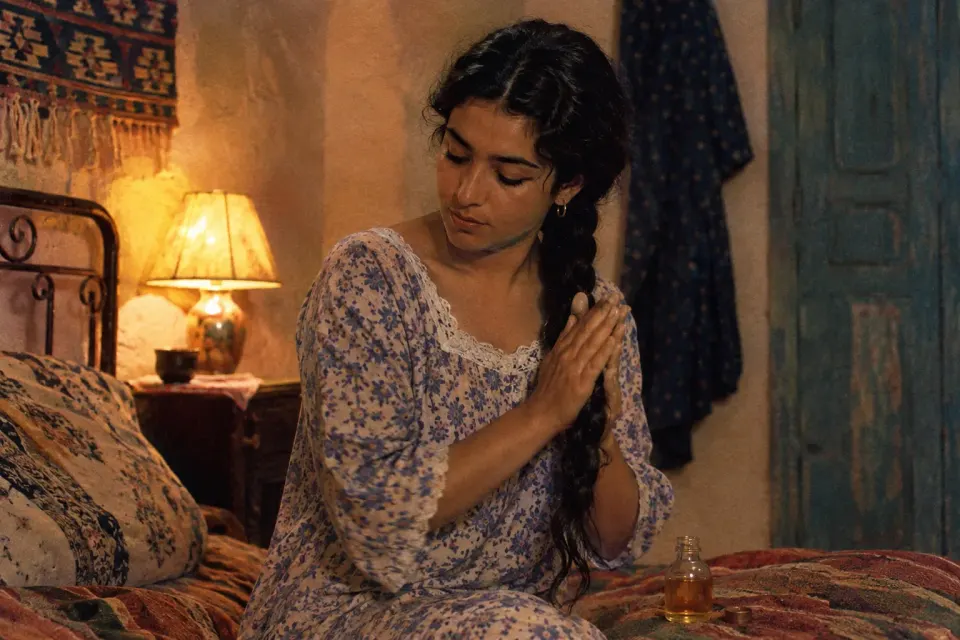
Two drops of Moroccan argan oil, warmed in your palms and pressed into damp ends: the 5-minute way to soften dry, frizzy ends.
For you if the last 2 inches (5 cm) of your hair feel like straw and frizz up by the afternoon, whatever conditioner you use.
Ask a Moroccan grandmother what she puts on her hair after the hammam, and she will show you a small bottle of zit argan — argan oil, pressed by Amazigh women in the Souss. Not a mask. Not a long routine. Two drops, warmed in the palms, pressed into the ends while the hair is still a little damp. That is the whole method.
Oil does not belong on every root, and it does not replace water. If your ends feel rough and frizzy by the afternoon, this is the gesture to borrow.
In the United States, heated rooms dry hair out all winter: from November to March, give your ends one more drop than usual.
The ends are the oldest part of your hair. On shoulder-length hair they have been through two or three years of washing, sun and brushing. The natural oil of your scalp rarely travels that far, especially on wavy or curly hair, so the top of your head can feel flat while the last 2 inches (5 cm) feel like straw. Two needs can live on the same head. That is why Moroccan women finish their hair at the ends and leave the roots alone: the scalp wants to be clean, the ends want softness.
It is also why the habit is small and frequent. Dry ends need a little oil often, not a lot of oil once.
Zit argan is the last gesture after the hammam, when the hair has been washed, squeezed in a towel and is still holding a little water. The order matters. Oil does not add water to hair; it sits on the surface and slows down the water that is already there from leaving. Pressed onto damp ends, two drops keep them supple until the evening. Rubbed onto bone-dry, rough ends, the same oil only gives an hour of shine.
Frizz is often just a rough surface, where light scatters instead of bouncing back. When a trace of oil lays that surface flat, the hair catches the light again. That is all shine really is, and it is why dull, frizzy ends are rarely dirty hair.
The argan tree grows in one place on earth: southwestern Morocco, between Essaouira, Agadir and the Anti-Atlas, the region Moroccans call the Souss. Amazigh women crack the nuts by hand, and many work in cooperatives they run themselves. The oil for hair and skin is pressed from unroasted kernels; the roasted ones give the nutty oil Moroccans eat with bread. UNESCO protects the argan forest as a biosphere reserve and lists the know-how of these women as heritage of humanity.
These women have always used the oil sparingly, on hair, hands and skin. A real bottle is small because the work behind it is long, and two drops is a real amount. A product that needs a full pump to do anything is usually mostly silicone with a little argan in it, which is a different thing; we come back to it below.
Step 1
After a wash, press your hair in a towel or an old cotton T-shirt. Never rub: rubbing roughens the surface you are trying to smooth. Wait until nothing drips. Between washes, wet your hands, shake them off and smooth them once over the last third of your hair. You want the ends damp, as they are when you walk out of the hammam, not wet.
Step 2
Hold a section in your fist just above the knot, so the roots feel nothing. With a wide-tooth comb, free the last 2 inches (5 cm) first, then move up one hand at a time. Curly or coily hair: fingers first, the comb after. Much of the roughness you feel at the ends comes from knots pulled out in a hurry, so this minute counts as much as the oil.
Step 3
Pour the oil into your palm, never straight onto your hair; it is the easiest way to keep the amount small. Two drops for shoulder-length hair, three for long or thick hair, one for fine hair. Rub your palms together, the way Moroccan women do after the hammam, until the oil is warm and your hands only shine.
Product for this step
Oil · Amazon.com
0 reviewsStep 4
Take the last third of your hair between your palms and press, as if you were closing a book. Press, do not rub. Stay a little longer on the very tips, then run your fingers through once. Keep below the ears: nothing goes on the roots.
Product for this step
Oil · Amazon.com
0 reviewsStep 5
Your hands still carry a trace of oil, and that trace is enough. Pass your palms lightly over the surface from mid-length down, then over the flyaways on top. Do it in daylight, near a window: you see at once where the shine is missing, and where to stop.
Step 6
Many Moroccan grandmothers keep this gesture for the evening, every evening, for years. If you do the same, finish with a loose braid: it keeps the oil on the hair and off the pillow. In the morning your ends are soft, not greasy.
A small tip: keep the bottle next to your toothbrush. You will never forget your two drops again.
Too much oil. If your hair looks shiny with oil, it was too much. Go down to one drop next time. On fine hair, half a drop is a real amount.
Oil too close to the roots. Hair that feels heavy, flat or greasy afterward almost always means the oil went too high. Keep it on the last third.
Oil on ends that are completely dry, with nothing underneath. There is no water for it to hold in. Dampen your hands first.
Product piled on product. Dry ends rarely need more products; they need gentler hands. Judge the result once your hair is fully dry: it should feel soft and move freely. If the ends are already soft today, skip the oil. Doing less is a routine too.
Asking the oil to do another job. Zit argan is the finish, not the wash. It does not replace your shampoo or your conditioner.
Your scalp sets the rhythm, not a rule: wash as often as it gets oily or dusty. Massage shampoo into the scalp with your fingertips for about a minute and rinse until the water runs clear. Squeeze the water out, smooth conditioner from the ears down, leave it two or three minutes, comb it through with your fingers and rinse. Make the last rinse cool; it is the cheapest shine trick there is. Then the towel, and the two drops.
If you tie your hair up or cover it afterward, let the roots dry completely first, in the open air or with a dryer on low. Thick or long hair simply takes longer, and that is fine.
A leave-in conditioner is lighter than the conditioner you rinse out in the shower, and it is made to stay on the hair until the next wash. On days when the ends tangle, rub a pea-sized amount between your palms and smooth it from the ears down, pressing the ends a little longer. Wait a minute, then press a single drop of zit argan on top. Cream first, oil last: the oil is always the finish. If your hair starts to feel coated, skip a day or two.
Turn the bottle around. Pure argan oil has one ingredient: Argania spinosa kernel oil. Nothing before it, nothing after it. The oil is golden, with a faint nutty scent that fades a few minutes after you put it on. Look for a dark glass bottle, a small size (1 to 2 ounces, 30 to 60 ml, lasts a long time at two drops a day) and a label that says where the oil was pressed.
What a Moroccan grandmother would refuse: a bottle that smells of perfume, a long ingredient list sold as pure, clear plastic that has sat in the light, a price that seems too good for nuts cracked by hand, and the words Moroccan oil with no ingredient list at all.
An argan serum is a different product, not a fake. It is mostly silicone with some argan: it smooths and shines at once, and it washes out. If that is what you want before going out, buy it knowingly and check that argan really appears on the list. Whichever you choose, pick one made for hair and follow its directions.
A Bodywhatever™ selection: Moroccan care you can buy in the United States.
As an Amazon Associate we earn from qualifying purchases. Purchases, payment, delivery and returns are handled by the seller or marketplace, not Bodywhatever™. Prices and availability can change.
Use suitable products you already own. This selection may not cover every step; open CareFinder to apply your budget and label preferences.
Common questions
Damp is best: towel-dried hair spreads the oil more easily, so you need less, and the oil has water to hold in. On dry hair it still works as a finish; use one drop, or dampen your hands first. Either way, stay on the ends.
Less than you think. One drop for fine hair, two for shoulder-length hair, three for long or thick hair, always on the ends first. Add one more drop only if the ends still feel dry once the hair has dried.
Yes, at two drops and on the ends only; that is how the habit is kept in Morocco. If your hair starts to look heavy or stick together, use half as much, or keep the oil for every other day.
Two drops on the ends are made to stay: braid loosely and sleep. There is nothing to rinse in the morning. A generous oil bath before shampoo is another ritual, with its own page.
They do different jobs. For instant smoothness before going out, a serum. For ends that slowly become softer, pure oil in the evening. Many women keep both.
No oil glues a split end back together; only scissors remove it. What zit argan does is smooth the ends so they feel softer, look less frizzy and catch less on each other between two trims.
We will not promise that. What you can expect is softness and shine. Ends that are handled gently and oiled a little tend to break less, so your hair may keep more of the length it already has.
In the United States you can order it on Amazon. Bodywhatever™ keeps a short selection of what can be delivered there, so you do not have to search through hundreds of listings. Open it here:
 15 minutes
Ritual & routine · Hair Care
Water first, a cream if you need it, argan oil last: the Moroccan order that keeps curly hair soft and light until the next wash.
 30 minutes
Ritual & routine · Hair Care
Oil first, wash after: a teaspoon of Moroccan argan oil on dry hair, twenty minutes under a warm towel, then shampoo. The weekly hammam-day treatment.
You
Bodywhatever™
Curious about Moroccan argan? Start with the dry parts of your hair, not another layer on your scalp. We’ll explain how a finishing oil differs from shampoo and conditioner.
You
Bodywhatever™
Henna is a traditional Moroccan hair treatment that adds warm shine. Here is how it fits into real life.

Bodywhatever™ · CareFinder
Tell us about your hair or skin and your current habits. CareFinder explains where Moroccan ingredients fit and puts together care steps, with product options in the United States.
Find my care planFree · Email code · Saved in My Bodywhatever™
Make money with Bodywhatever
Create your bwe page for free. Share your routines, add your Amazon links and earn when people buy what you recommend.
Free. Takes 5 minutes. Sign in with an email code, no password.

Turn your wash day, skin night or hammam ritual into simple steps.
Pick the products you really use and add your own affiliate links.
Put one link in your bio and see your page views and product clicks.
 Find it on Amazon