Notes on Moroccan beauty traditions and their place in the everyday lives of women in Singapore. Stories, perspectives and ideas connecting culture with your day.
A deep red that comes out of a small clay pot when you wet it. Where aker fassi comes from, how to apply it, how to avoid stains, and how to spot a fake.
In Morocco, rose water is not a luxury. It is sprinkled on guests, mixed into the hammam clay and misted on the face. Here is where it comes from, how it is really used, and how to choose a pure one.
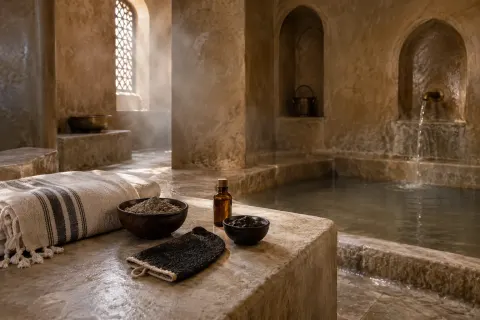
You do not need a marble steam room. Here is the order of a Moroccan hammam you can copy in an ordinary bathroom, what to buy first, and what you can skip.
Rough elbows, dull skin after a sweaty day, or make-up and dust that never quite comes off? Here is how to use Moroccan black soap with a kessa glove, how often, and who should be careful.
Oily at the roots and dry at the ends is common in warm weather, especially under a headscarf. Here is where argan oil goes, how many drops to use, and where to leave it off.
Black soap, a kessa glove, a gritty scrub and an exfoliating lotion all remove dead skin. Using all of them in one shower is the fastest way to red, stinging skin. Here is how to choose one.
You can explore Moroccan care without replacing the products that already suit you. Choose a gesture that fits your day, then learn where it comes from.
Three bottles do not necessarily mean three necessary steps. Read their directions, see what your current conditioner already does, and choose what belongs after your next wash.
Prickly pear seed oil is pressed from the tiny seeds of a cactus fruit that grows across southern Morocco. It is one of the most precious oils in Moroccan beauty. Here is why it is rare, how to use a few drops, and how to spot a fake.
Henna is known from weddings in many cultures. In Morocco, it is also a hair ritual and the centre of the bridal henna night. Here is how Moroccan women use it, how to colour and condition hair with it, and why you must avoid black henna.
Ghassoul (rhassoul) is a Moroccan mineral clay. Mixed with water into a soft paste, it cleans hair, face and body without foam. Here is how to mix it, how long to leave it on, and who should go gently.